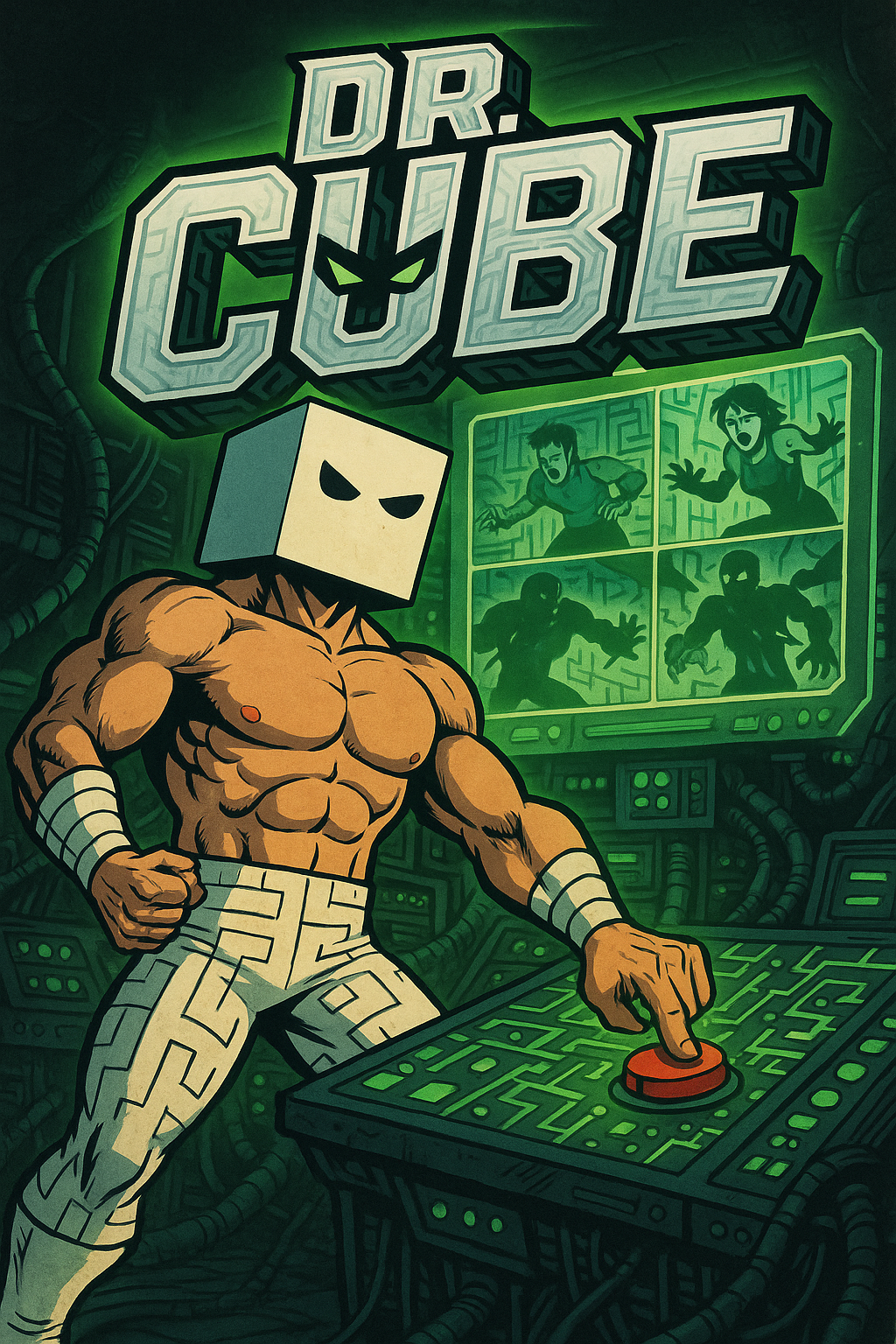
Dr. Cube
Inevitability
Do you want to play a game, Mr. Grimm?
You present yourself as something already resolved. You don’t argue danger, you presume it. Death on a motorcycle. An engine note as prophecy. A helmet shaped like a skull so no one forgets what you represent. You don’t threaten because you don’t believe you need to. You call yourself a fact. An endpoint. An inevitability no one escapes.
So here’s the condition in effect: inevitability only matters if it requires action.
You’ve positioned yourself as something beyond conflict. You don’t chase souls, you collect them. You don’t hate, you just arrive. Everything about you is designed to suggest that resistance is irrelevant, Mr. Grimm. That struggle is a misunderstanding. People don’t beat death—they simply meet it.
That framing is elegant. But it’s also incomplete.
You see, inevitability without agency doesn’t apply pressure. It waits. It relies on time doing the work. You don’t force outcomes, Mr. Grimm. You assume them. You don’t impose will, you lean on certainty. And certainty is comfortable when no one asks what happens if the ending doesn’t arrive on schedule.
Your myth depends on belief. On the sound of the engine meaning more than the decisions that follow it. On people freezing because they think the conclusion is already written. You benefit from the pause. From the assumption that nothing done in the present can matter.
But games aren’t beaten through symbolism, Mr. Grimm.
When nothing collapses on arrival, when no one panics at the omen, your role becomes strangely passive. You linger. You loom. You wait for fate to remember you. And waiting is the one thing death is never supposed to do.
That’s the contradiction at the center of you. You claim inevitability, but you behave like an appointment hoping to be kept. You ride in as conclusion, yet you still need participation for the ending to occur. Without it, you’re just atmosphere—impressive, unsettling, and functionally inert.
You don’t adapt because adaptation would admit choice. You don’t escalate because escalation would admit effort. You present yourself as beyond malice, beyond urgency, beyond need. Conveniently, that distance protects the image. But it also strips you of leverage.
Because the moment someone stops treating you as destiny and starts treating you as a variable, the spell weakens. They stop listening for the engine and start watching what you actually do, Mr. Grimm. And what you do relies heavily on everyone agreeing that the story is already over.
This match, you see, doesn’t ask whether death is inevitable. That question is too large to hide inside. It asks something smaller and more dangerous: what happens when inevitability has to act instead of arrive?
Because if you remain what you claim to be, you wait for an ending that isn’t guaranteed to happen. And if you abandon the myth to force one, you admit that death, as you perform it, isn’t actually a law—it’s a charade.
That’s the game, Mr. Grimm. Not escaping you.
But reducing you.
And once inevitability is reduced to participation, it has to earn what it used to assume.